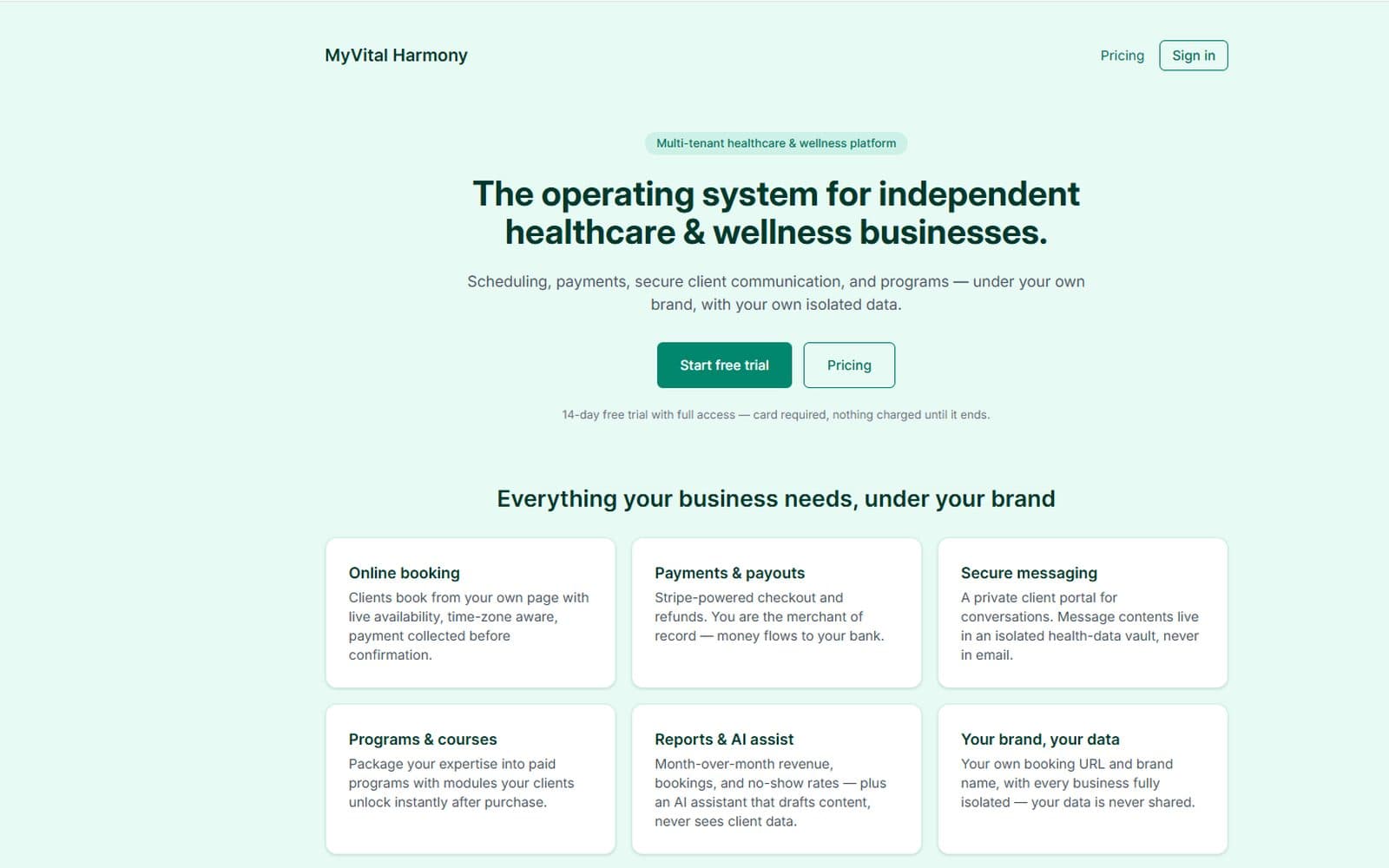
Overview
MyVital Harmony is a multi-tenant healthcare and wellness platform that connects patients, providers, clinics, and wellness businesses through secure digital workflows. Each business runs under its own brand with isolated data, giving solo practitioners the kind of infrastructure that is usually reserved for large healthcare organizations.
Problem
Independent healthcare and wellness professionals lose hours every week to fragmented tooling: one product for booking, another for payments, spreadsheets for client records, and email threads for everything else. None of those tools treat health information with the care regulated work demands, and none of them let a small business present a professional, branded experience to its clients.
Users
- Solo healthcare and wellness practitioners
- Small clinics and multi-provider teams
- Front-desk and support staff
- Patients and wellness clients booking and paying online
Goals
- Give every tenant a branded workspace with strictly isolated data
- Consolidate scheduling, payments, messaging, and programs into one system
- Design for healthcare-grade privacy from the first schema onward
- Keep pricing and onboarding simple enough for a one-person business
My role
Founder and sole developer — product strategy, UX design, full-stack implementation, payments integration, security architecture, and cloud deployment.
Product strategy
Rather than building another point solution, MyVital Harmony is positioned as an operating system: the platform earns its place by replacing four or five subscriptions at once. Subscription tiers scale from a single provider to enterprise teams, and a free trial lowers the barrier for practitioners who are skeptical of new software.
Key features
- Multi-tenant workspaces
- Every business operates under its own brand with database-level tenant isolation, so one tenant's data can never leak into another's queries.
- Scheduling & service management
- Online appointment booking, provider availability, and service catalogs built around real clinic workflows.
- Payments with Stripe & Stripe Connect
- Platform subscriptions and per-business payment processing, including connected accounts so each tenant is paid directly.
- Secure client messaging
- Provider–client communication kept inside the platform instead of scattered across personal email and SMS.
- Digital programs & products
- Practitioners can package courses and programs as digital products, adding recurring revenue beyond appointments.
- Role-based access control
- Owners, providers, staff, and clients each see exactly the workflows and records their role requires — nothing more.
Technical architecture
- Multi-tenant SaaS architecture with database-level tenant isolation
- Role-based access control spanning owners, providers, staff, and clients
- Append-only audit trails for sensitive operations
- Encrypted health-data storage separated from the primary application data
- Transactional email for onboarding, booking, and billing events
- Cloud deployment designed for low-maintenance operation
Security & privacy
- Designed around healthcare privacy, access control, and data-separation principles from the start
- Tenant isolation enforced at the database layer, not just in application code
- Sensitive health data encrypted and stored apart from operational data
- Append-only audit logging for accountability over sensitive records
- No compliance certification is claimed; the platform is engineered with regulated-healthcare security considerations in mind
Engineering challenges & decisions
Making true multi-tenancy safe: a single missed tenant filter in a query is a data breach in a healthcare context.
Tenant isolation was pushed down to the database layer and treated as an architectural invariant rather than a per-query discipline, with audit trails to verify access patterns.
Supporting platform billing and per-business payouts at the same time.
Stripe subscriptions handle platform tiers while Stripe Connect routes client payments to each business's own account, keeping the platform out of the money-handling path.
Serving both a solo practitioner and a multi-provider clinic without two codebases.
Role-based access control and per-tenant configuration let the same workflows scale from one provider to a team, with tiered plans mapping onto the same underlying model.
Lessons learned
- Security architecture is cheapest at the schema stage — retrofitting isolation is far harder than designing for it.
- Small businesses buy outcomes, not features: pricing and onboarding copy mattered as much as the code.
- Payments edge cases (trials, upgrades, connected accounts) deserve as much design time as the happy path.
Future improvements
- Deeper reporting and analytics for practice owners
- Expanded program/course authoring tools
- Planned pharmacy and medication-network integrations